On March 4, the Experiment and Information Center of the Economics and Management School hosted a teaching session titled "Smart Leading Future Classroom – AI-Empowered Simulation Teaching: Integrating Assistant Intelligence with Coaching Art" in Laboratory 378. The event featured Graeme Kirkup, VP and Global Head of Corporate Training at CESIM, as the keynote speaker, with on-site translation by Wu Wen, General Manager of CESIM China. Organized by Zhu Geqian, Head of CESIM Central China, the event brought together faculty from our school and other institutions to explore new pathways for integrating AI technology with business simulation teaching.

At the outset of the event, XU Xiaohui, Director of the Experiment and Information Center, delivered an opening address, welcoming Graeme Kirkup and his delegation. He noted that against the backdrop of rapid advancements in educational digitalization and artificial intelligence, exploring the deep integration of intelligent technology with teaching models holds significant importance for enhancing classroom interactivity and practicality. Business simulation teaching, by constructing decision-making scenarios close to real business environments, enables students to understand corporate operational logic and market competition mechanisms through practice, serving as a crucial pedagogical method for cultivating strategic thinking and comprehensive decision-making abilities.
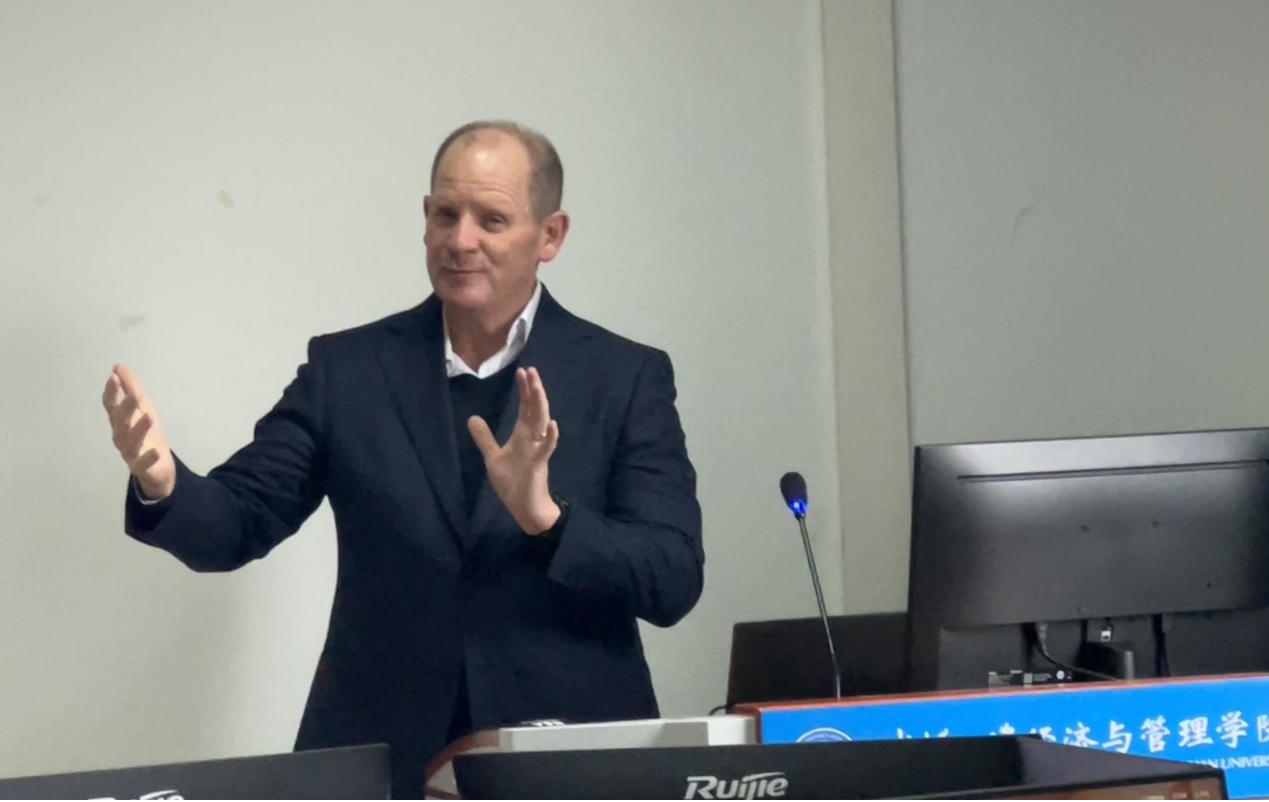
During the lecture session, Graeme Kirkup, drawing on years of experience in corporate consulting and training, introduced the CESIM business simulation methodology and its application in universities and corporate training globally. He emphasized that, compared to one-way knowledge transmission, simulation teaching places greater emphasis on students' active exploration through practice. Through continuous decision-making and feedback, students can progress from single-loop to double-loop learning and experience "A-HA!" moments of insight while understanding business logic. He further noted that effective simulation teaching typically comprises three elements: a simulation practice foundation, guided reflection and feedback for decision review, and ultimately, the transfer to real-world contexts, thereby connecting classroom learning with real-world business decision-making capabilities.
Addressing the application of artificial intelligence in teaching, Kirkup introduced the roles of AI Teacher Assistants and AI Student Coaches in simulation teaching. The AI Assistant supports the instructor by rapidly analyzing simulation-generated operational data and generating teaching feedback. The AI Coach supports students by offering guided questions and data prompts to aid decision-making, helping them understand operational logic and facilitating team discussions. He observed that with the advancement of AI technology, student use of AI tools has become commonplace. Teaching design should therefore guide students in using AI responsibly, positioning it as a crucial auxiliary tool for analysis and reflection.
In a practical demonstration session, Kirkup led participating teachers through a hands-on experience with the CESIM business simulation system. The simulation case was set in the hotel industry, with multiple teams each operating a 50-room hotel and competing in the market over several operational rounds. Each round represented a half-year business cycle. Teams made decisions regarding pricing, marketing, service quality, human resources, and investment, continuously adjusting their business strategies based on market feedback. Throughout the simulation, the system generated key data on revenue, cost structure, market share, and return on investment. Kirkup pointed out that business decision-making requires attention not only to profit and sales but also to long-term strategy and resource allocation. The course used cumulative shareholder return as the core evaluation metric to comprehensively assess team performance and guide students in reflecting on the impact of different strategies. After multiple rounds of simulated competition, Team Orange ultimately achieved victory.
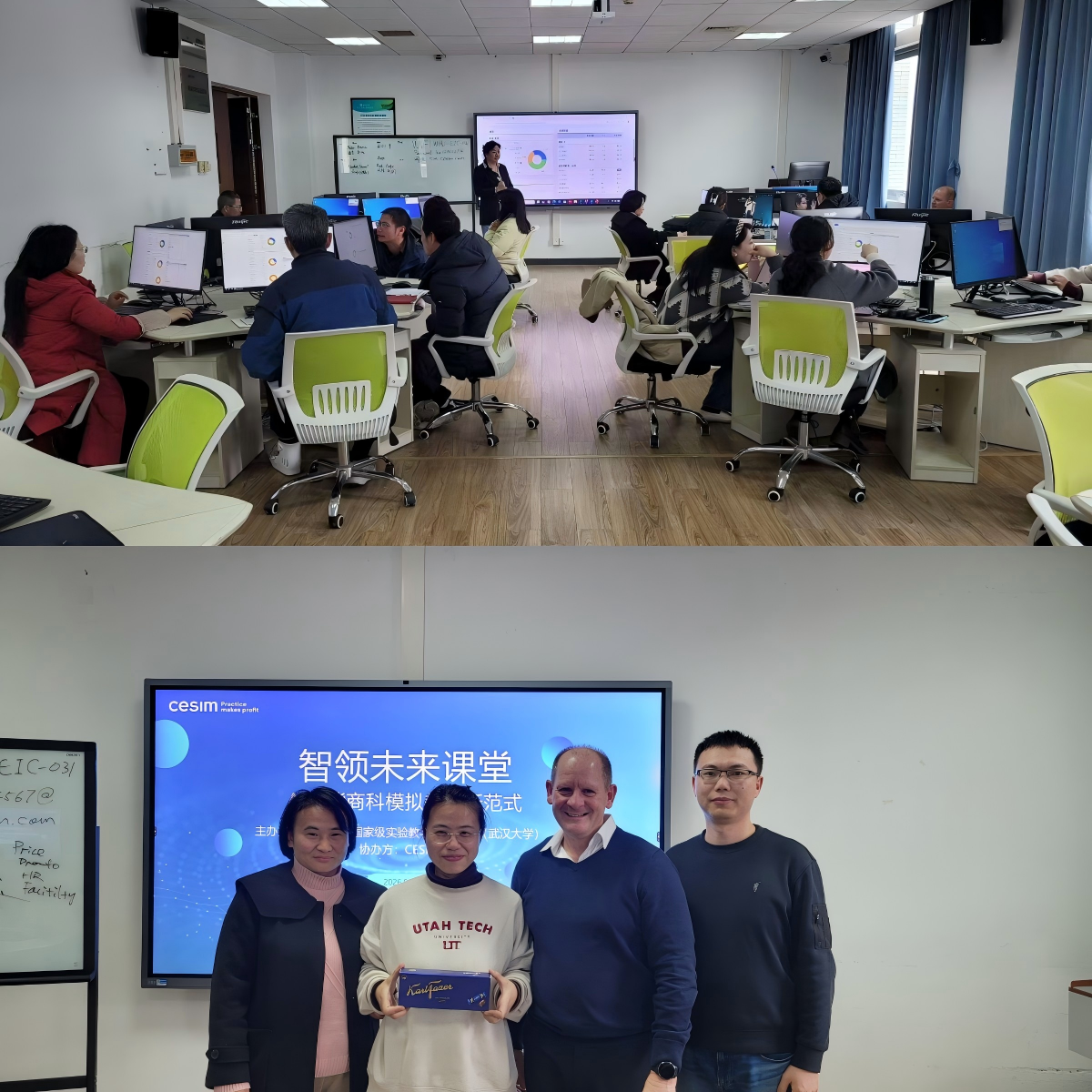
Following the practical demonstration, WU Wen further introduced the instructor's interface and operational procedures of the simulation system, showcasing its functionalities in course organization, data analysis, and teaching feedback. Subsequently, participating teachers engaged in discussions on the boundaries of AI application in teaching, methods for designing simulation courses, and future directions for intelligent teaching. Kirkup, drawing on practical experience from international universities, noted that high-quality simulation teaching relies not only on scenario design but also on creating a complete learning loop through continuous data feedback and reflective mechanisms.
This teaching exchange activity provided valuable insights for faculty members to deepen their understanding of the integration of business simulation teaching and artificial intelligence technology. Looking ahead, the School will continue to explore the integration of digital technology with teaching model innovation, promoting the evolution of classroom instruction towards greater interactivity, practicality, and intelligence, and continuously enhancing the quality of talent cultivation.
Reporter: Zhu Bochen
Reviewer: Sun Xiang


